
The Payment Is Not the Price
This week you move from seeing a payment to reading the contract, choosing a payoff order, and comparing a federal student loan repayment plan.
Chapter 7 · Consumer Credit · Snowball vs. Avalanche · Federal Student Loans
Here is where the class stands right now.
class average across the graded work included in this snapshot
class median
students in the grade export
Current distribution
What is driving the spread?
26 students have no zero among the six graded items in this snapshot.
18 students have at least one zero or missing graded item.
That helps explain why the mean sits below the median. Submitted work is generally much stronger than the overall average.
Discussion 2, The 70/30 Third Category, has been reopened and is now due Sunday, September 27 at 11:59 PM. Any Discussion 2 grade is excluded from both earned points and possible points in this class snapshot.
Snapshot basis: D1, A1, D3, D4, D5, and A2 only. Maximum possible in this snapshot: 220 points. No student names or individual grades are displayed.
The salesperson says: “It is only $78 a month.”
Thirty-six payments. Before you see anything else, what number would you want next?
Chapter 7 “special” price
What Berkeley could have paid.
36 × $78
Total scheduled payments.
The monthly payment is not the price. A payment is one term inside a contract.
Book scenario from Chapter 7. The $808 comparison uses the chapter's $2,000 special price and $78 × 36 payment schedule.
A real statement is trying to tell you more than “pay $54.”
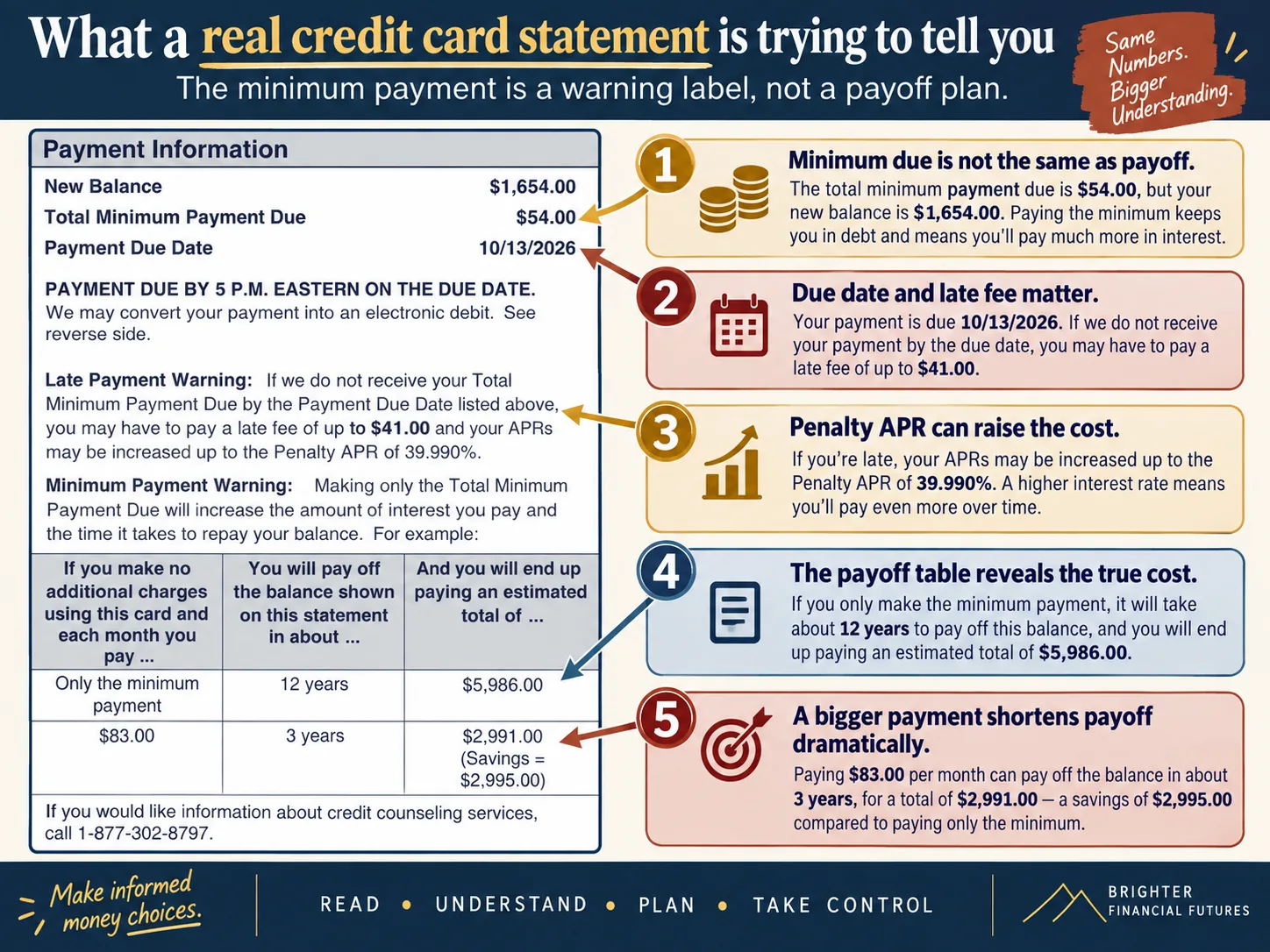
Minimum due
What keeps the account current this cycle. It is not a payoff plan.
Late terms
Fees and penalty APR language can change the cost after a missed payment.
Repayment box
The statement shows what minimum-only repayment can do to time and total cost.
Go get the contract before you give advice.
Use the CFPB credit card agreement database. Pick any issuer. Do not use your own card or disclose personal account information.
OPEN CFPB AGREEMENT DATABASEThe CFPB database contains general terms, pricing, and fee information submitted by issuers. Account-specific terms may differ. Use this as an evidence exercise, not as a substitute for a cardholder's own agreement.
Snowball and avalanche solve different human problems.

Snowball
Creates an early win and frees a payment sooner. Behavior is the argument.
Avalanche
Targets the most expensive dollar first. Interest cost is the argument.
Same $350 monthly debt budget. Which order would you sign your name to?
Store card
18% APR · required payment $30
Visa
29% APR · required payment $120
The borrower can pay $350 total each month: both required payments plus $200 extra. No new charges.
Choose a strategy. The calculator will roll freed payments forward and keep the total monthly budget at $350.
Classroom case. Required payments are supplied as fixed amounts for comparison. Real credit card minimums can change under the issuer's agreement.
In this case, both finish in about 17 months.
Snowball
interest · Store card first
Avalanche
interest · Visa first
Do not treat federal loans like another credit card.

Repayment Assistance Plan (RAP)
For eligible borrowers, payment is income-based. The Department says payments run from 1% to 10% of income, with a $50 monthly reduction per dependent. On-time payments can receive unpaid-interest relief and a principal matching benefit.
Tiered Standard
Fixed monthly payments with a repayment term tied to total debt: 10, 15, 20, or 25 years.
A lower required payment can come with a different path.
RAP example
Unmarried borrower · no dependents · $35,000 debt · $45,000 income
The Department's example also shows $40 of unpaid interest waived each month and a $50 monthly principal matching payment.
Tiered Standard example
$30,000 initial loan balance
15-year term in the Department's example, compared with $341 under the old 10-year standard example.
These are two separate Department examples, not a head-to-head quote for the same borrower. That distinction matters.
Avery · single · no dependents · AGI $45,000 · $35,000 Federal Direct Unsubsidized Loan · 6.50% fixed rate · first disbursed August 2026.
Use manual entry while logged out. Do not sign in and do not use your own loan record. Compare the eligible fixed-payment path with RAP and record the calculator's current estimates. If RAP or Tiered Standard is not shown in the first results, choose “View More Plans.”
Snowball or Avalanche, Plus Your Federal Loan Plan Comparison
Due Sunday, September 27 at 11:59 PM.
Complete the Week 6 lesson first. In 225–300 words:
- Using the supplied $800 store card and $4,000 Visa case, choose snowball or avalanche. Cite the payoff order and interest difference from the lesson.
- Name one behavioral or cash-flow fact that could make you recommend the other strategy.
- Then use the StudentAid.gov Repayment Calculator with the supplied federal-loan profile in the discussion instructions. Compare the eligible fixed-payment path with RAP. If RAP or Tiered Standard is not shown in the first results, choose View More Plans. Report the monthly payment and one long-run tradeoff the calculator shows.
- End with the advice you would give the supplied borrower and one fact that would change it.
Then make two substantive replies. Challenge the strategy, check a number, or identify a missing fact that could change the recommendation.
30-point grading structure
6 · consumer-debt evidence 6 · strategy judgment 6 · federal-plan comparison
6 · substantive reply 1 6 · substantive reply 2
Write your debt decision rule before you need it.
No balances. No account numbers. No confession. Just the rule you want your future self to remember.
The Two Offers
Next week we move from debt to the job offer. I am opening the assignment now because some of you are already interviewing.
Offer A
$66,000 salary · 2% full 401(k) match · immediate vesting · $280/month employee health premium · no employer HSA contribution · 10 PTO days
Offer B
$61,000 salary · 6% full 401(k) match · 3-year cliff vesting · $90/month employee health premium · $1,200 employer HSA contribution · 20 PTO days
Your assignment will price the pieces, test what vesting does if the employee leaves early, compare the result with current BLS compensation data, and make a recommendation.
Build your Week 6 prep note.
Nothing here submits automatically. Your agreement notes and private rule stay on this device unless you copy them.
This is what closes this week.
Sunday, September 27 · 11:59 PM
Discussion 2 REOPENED · The 70/30 Third Category
Discussion 6 · Snowball or Avalanche, Plus Your Federal Loan Plan Comparison
Open now, not due this week
Assignment 3 · The Two Offers · due Sunday, October 4 at 11:59 PM
Next week: total compensation through supplied cases. Chapter 17 stays closed for now so later Berkeley decisions are not spoiled.
A required payment tells you what you must send now. A financial decision asks what the contract costs over time.